
How large projects get performance security when one surety isn’t enough — co-surety, US vs Canada norms, and subcontractor default insurance vs traditional surety.
Last verified: September 28, 2026 (PT)
This page is an education-first overview for brokers, underwriters, and contractors who work large construction and tech-infrastructure programs — data centers, energy, and civil megaprojects. It explains, in plain language, why large limits often need more than one surety, how US and Canadian bond-size norms differ, and how subcontractor default insurance differs from traditional surety bonds. The goal is better questions for owners, lenders, and sureties — not a product pick.
Verify at source / not legal advice. Bond percentages, FAR thresholds, tender requirements, and product terms change. Always confirm in the solicitation, current regulation, and the bond or policy forms before relying on any figure on this page. This is general industry education for Global Guarantors Learn — not legal, underwriting, or claims advice. When in doubt: qualified counsel, the owner’s bond forms, and the surety’s underwriting team.
Large projects often need more performance security than a single surety can (or will) put on one risk. That is not a judgment about the contractor — it is a statement about finite capacity. Every surety has limits on how much exposure it will take on a single principal, a single project, and across that contractor’s whole backlog.
Data-center builds, energy programs, and civil megaprojects are competing for much of the same bonding capacity. Industry explainers describe the surety market as well capitalized overall, while still seeing aggregate strain when multi-billion programs run concurrently. Owners who ask for oversized security, and contractors who stack large jobs without planning capacity, can lock up scarce lines that would otherwise support the next award.
This page exists so brokers and project teams can:
It does not recommend a product, invent capacity numbers, or substitute for underwriting or counsel.
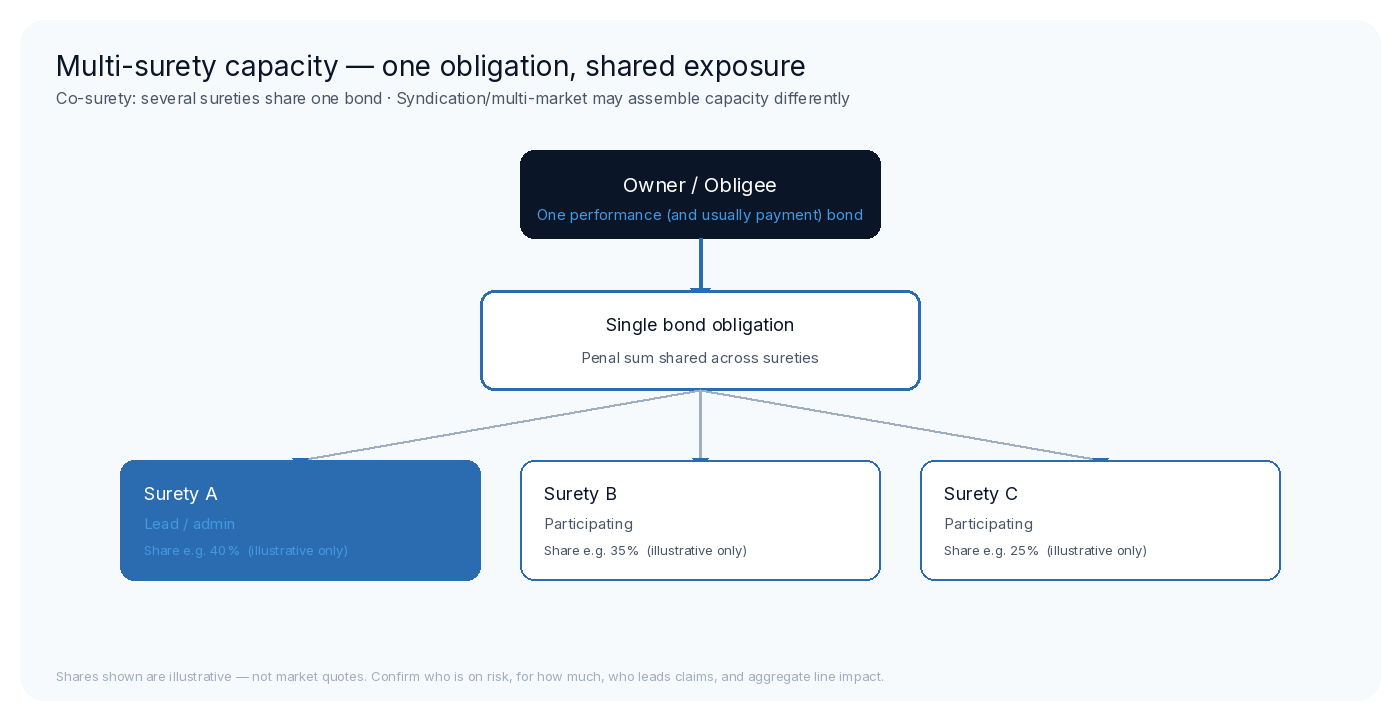
When the bond amount is too large for one company to carry alone, several sureties can jointly stand behind the same obligation. Each takes a share of the exposure. From the owner’s seat, there is still a performance (and usually payment) bond; behind the scenes, more than one surety is on the risk.
That arrangement unlocks higher aggregate limits than any single market might write. It also adds coordination work: who leads if there is a claim, how capacity is allocated across a contractor’s backlog, and how each surety’s reinsurance treaties sit behind the primary line.
Industry commentary (for example Aon’s April 2026 megaproject capacity piece) describes greater use of these multi-surety structures as project sizes grow and concurrent backlogs press against aggregate lines. Swiss Re Corporate Solutions similarly lists syndicated facility and co-surety solutions among tools used for large and complex international bonding needs. Treat those as industry explainers of structures, not as Global Guarantors capacity quotes.
| Term | Plain meaning |
|---|---|
| Co-surety | Two or more sureties share the obligation on one bond. Each typically takes a defined share of the penal sum (the maximum amount the bond can respond for). One surety often leads administration and claims handling, with the others participating per the co-surety arrangement. |
| Syndication / multi-market program | Capacity is assembled across markets — sometimes as a program or facility rather than a single co-signed bond. The practical goal is the same (enough capacity for a large limit); the paperwork and how markets participate can differ. |
Readers do not need to master every internal label. What matters for owner and contractor conversations is: who is on the risk, for how much, who leads a claim, and how this job sits against the contractor’s remaining aggregate line.
Do not invent capacity figures. Public sources discuss co-surety and syndication as tools; they do not authorize quoting “typical” megaproject limits or market shares as if they were verified deal data. Confirm capacity with the markets underwriting the account.
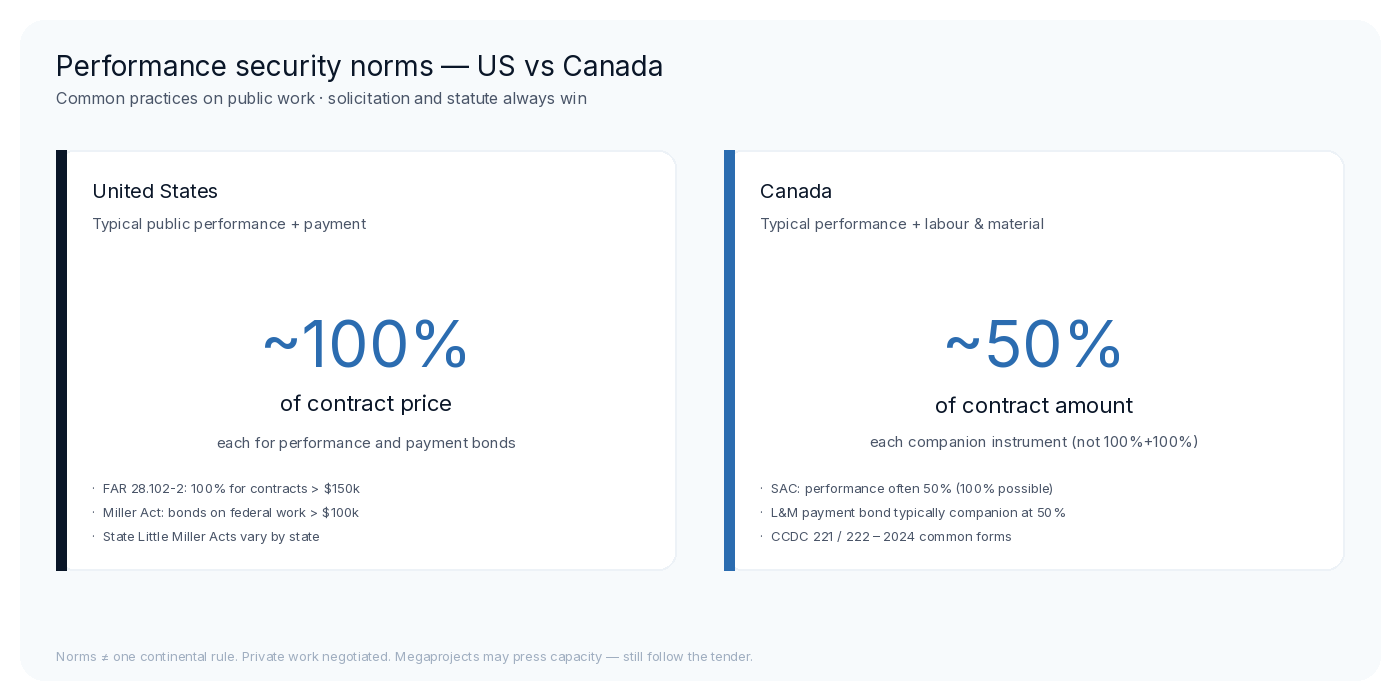
On many US public construction jobs, owners typically require a performance bond and a payment bond each set at about 100% of the contract price. In Canadian practice, owners commonly ask for about 50% of the contract amount on a performance bond and about 50% on a labour-and-material payment bond — two companion instruments that together aim at covering the project’s cost exposure, not a “double stack” of 100% + 100%.
Aon’s regional overview of typical performance-bond levels lists the United States at 100% and Canada at 50% (other markets often differ — see Aon’s megaproject performance-security article). Those figures are norms and solicitation-driven practices, not a single continental statute.
Federal Acquisition Regulation (FAR) 28.102-2 sets the amounts for bonds on covered federal construction contracts. For contracts exceeding $150,000:
Source: FAR 28.102-2 — Amount required (Acquisition.gov; FAC 2026-01, effective March 13, 2026 as shown on the page when verified).
The Miller Act, at 40 U.S.C. § 3131, is the statute requiring performance and payment bonds before award of a federal contract of more than $100,000 for construction, alteration, or repair of a public building or public work. The Act requires a performance bond in an amount the officer considers adequate, and a payment bond generally equal to the total amount payable under the contract (with a written-findings exception parallel to the FAR). The FAR implements and details the bond amounts used in federal contracting practice — including the $150,000 contract-value band described above.
Pending verification / threshold nuance: The Miller Act’s statutory trigger is more than $100,000. FAR 28.102-2’s detailed 100% performance-and-payment rules apply to contracts exceeding $150,000, with a separate payment-protection rule for contracts exceeding $35,000 but not exceeding $150,000. Always use the current FAR text and the solicitation — do not collapse the statute and the regulation into one number without checking both.
State “Little Miller Act” statutes often require bonds on state and local public work, but percentages and thresholds vary by state. Some states allow lower performance percentages on some project sizes; others track closer to the federal 100%/100% pattern. Private work is negotiated. Always read the solicitation and applicable state statute.
The Surety Association of Canada (SAC) explains, in educational materials for owners and industry:
Sources: SAC — Performance Bonds; SAC — Labour & Material Bonds.
The common Canadian form set for many projects is the Canadian Construction Documents Committee (CCDC) bond forms. The 2024 editions include:
Source: CCDC 220, 221, 222 – 2024 Bond Forms.
The form standardizes wording and claim options; the bond amount still comes from the tender documents or contract, not from the form alone. Some Canadian public owners (and some provincial statutes for public contracts) set minimums around 50%; others require higher. Confirm the tender.
| Point | Takeaway |
|---|---|
| Norms ≠ one rule | US ~100% / Canada ~50% are common practices, especially on public work — not a single North American percentage. |
| Solicitation wins | The invitation to tender / RFP / contract sets the required amounts and forms. |
| Private work | Often negotiated; lenders may push for higher security even where public norms are lower. |
| Megaprojects press norms | Industry commentary notes that extremely large projects can make a literal 100% performance bond impractical, pushing owners and markets toward right-sized requirements and multi-surety structures. That is a capacity conversation — not a license to ignore a solicitation that still calls for 100%. |
Secondary vocabulary (after the plain comparison): penal sum = the maximum dollar amount stated on the bond; Little Miller Act = state analogues to the federal Miller Act; CCDC 221 / 222 = the common Canadian performance and labour-and-material payment bond forms.
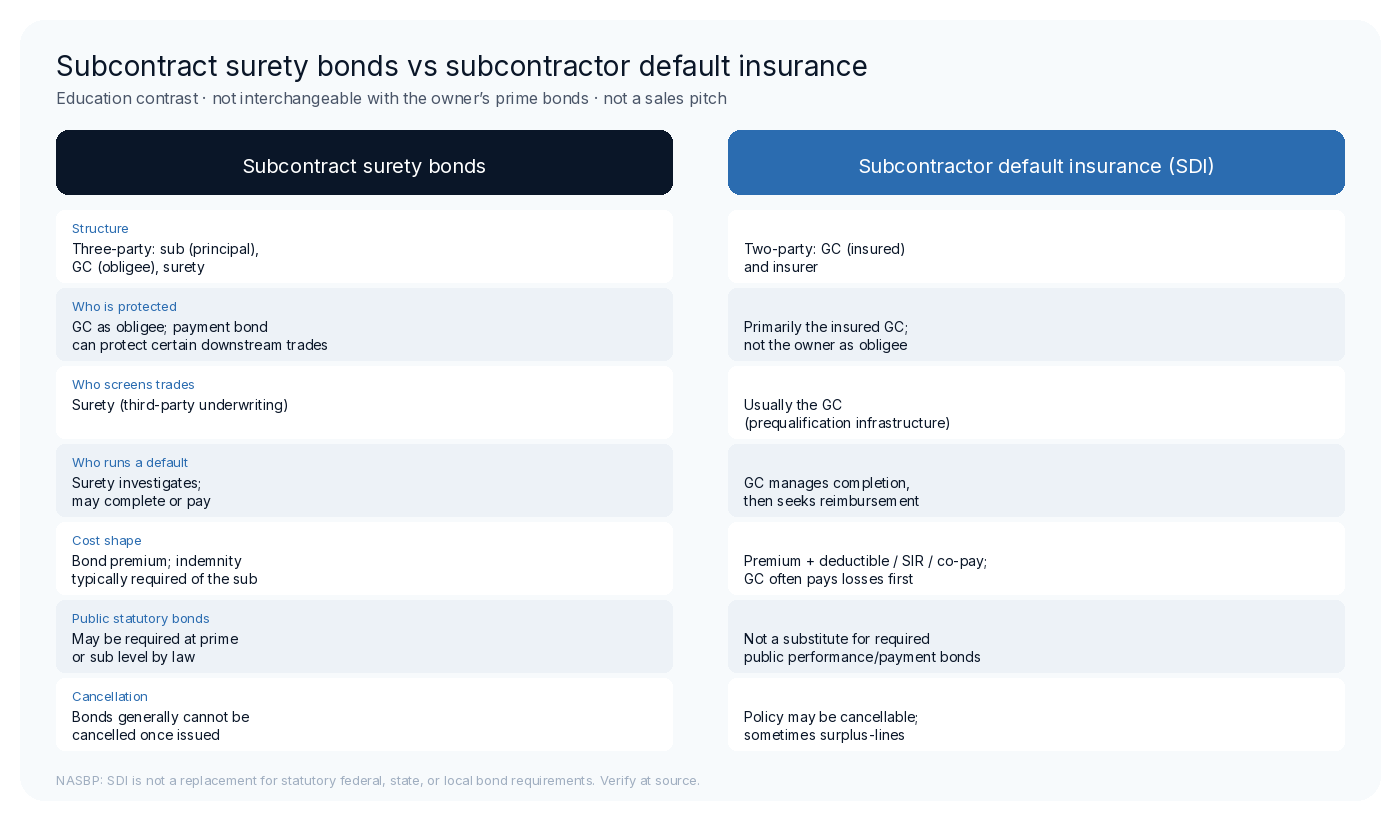
This section is education, not a sales pitch. Both tools address trade-level default risk. They are built differently, protect different parties, and are not interchangeable with the owner’s prime performance and payment bonds — especially on public work.
Subcontract surety bonds (traditional surety at the trade level)
A three-party arrangement: the subcontractor (principal), the general contractor (obligee), and the surety. The surety prequalifies the subcontractor. If the sub defaults, the surety investigates and may arrange completion, finance completion, or pay up to the bond amount. Risk transfer to the surety is typically first-dollar for covered obligations under the bond (subject to the bond terms). A payment bond at this level can also protect lower-tier suppliers and subs who furnish labor or material to the bonded subcontract.
Subcontractor default insurance (often called SDI)
A two-party insurance policy between the general contractor (insured) and an insurer. It is designed to reimburse the GC for covered costs of a trade-contractor default. The GC usually prequalifies the trades, retains a large deductible or self-insured retention (SIR) and often a co-pay, pays losses first, then seeks recovery from the insurer under the policy. Benefits flow to the insured general contractor, not to the project owner as obligee, and not as a statutory payment remedy for downstream trades.
| Topic | Subcontract surety bonds | Subcontractor default insurance |
|---|---|---|
| Who is protected | GC (as obligee); payment bond can protect certain downstream suppliers/subs | Primarily the insured GC; downstream payment protection is not the product’s job |
| Who screens trades | Surety (third-party underwriting) | Usually the GC (must invest in prequalification infrastructure) |
| Who runs a default | Surety investigates and may complete or pay | GC manages completion, then seeks reimbursement |
| Cost shape | Bond premium tied to subcontract / bond amount; indemnity typically required of the sub | Insurance premium plus retained loss (deductible / SIR / co-pay); no “bond premium vs insurance premium” figures are quoted here — ask markets for current terms |
| Public statutory bonds | May be required at prime or sub level by law | Not a substitute for required public bonds |
| Cancellation / regulation | Bonds generally cannot be cancelled once issued; sureties are typically admitted and state-regulated | Policy may be cancellable; may be written on a surplus-lines / non-admitted basis in some placements |
The National Association of Surety Bond Producers (NASBP) flash guide on subcontract bonds and SDI is explicit: SDI is not a replacement for statutory federal, state, or local bond requirements, whether those requirements sit at the prime or subcontract level. Public performance bonds protect publicly funded investments with first-dollar coverage of contractor default; public payment bonds give unpaid trades and suppliers a remedy where mechanics’ liens against public property are unavailable. A GC’s SDI program does not answer those public-policy purposes.
Primary source: NASBP — Flash Guide: Subcontract Bonds and Subcontractor Default Insurance (NASBP; guide text dated November 2015; PDF hosted on nasbp.org as of verification date).
Industry regional instrument tables (see Aon) describe subcontractor default insurance as available in the US and Canada, and not as a standard tool in several other regions. That is a geographic availability observation — not a recommendation to use SDI on any given job.
Secondary explainer (firm article — orientation only): Stoel Rives — Surety Bonds vs. Subcontractor Default Insurance (September 2021). Useful for the three-party vs two-party framing; do not treat firm premium ranges, deductible examples, or case-count statements as Global Guarantors figures or as a substitute for NASBP / statute / tender requirements.
Three construction-side pressures show up repeatedly in industry capacity discussions:
Power and interconnection (mention only): Data-center programs often add post-construction financial guarantees tied to grid interconnection and power agreements that can compete for the same capital pool as construction bonds — see Aon’s megaproject performance-security discussion for instrument-mix context. Deeper treatment belongs in a follow-up Learn post, not here.
No invented premiums, ratings, “typical” deal structures, or anonymized Global Guarantors case examples appear on this page. Use public sources and the markets on the account for live numbers.
Primary and association / government sources lead. Firm articles are labeled secondary.
| # | Source | What it supports | URL |
|---|---|---|---|
| 1 | FAR 28.102-2 (Acquisition.gov) | US federal performance and payment bond amounts (100% of original contract price for contracts exceeding $150,000; CO exceptions) | https://www.acquisition.gov/far/28.102-2 |
| 2 | 40 U.S.C. § 3131 (Cornell LII / Miller Act) | Statutory federal bond requirement for public buildings or works (contracts of more than $100,000) | https://www.law.cornell.edu/uscode/text/40/3131 |
| 3 | Surety Association of Canada — Performance Bonds | Typical Canadian performance-bond amount (~50%; 100% also possible) | https://suretycanada.com/SAC/SAC/Surety-Bonds/Performance-Bonds.aspx |
| 4 | Surety Association of Canada — Labour & Material Bonds | Typical Canadian L&M payment-bond amount (~50%; companion to performance; 100% also possible) | https://suretycanada.com/SAC/SAC/Surety-Bonds/Labour-Material-Bonds.aspx |
| 5 | CCDC 220, 221, 222 – 2024 Bond Forms | Common Canadian bid, performance, and labour-and-material payment bond forms (2024 editions) | https://www.ccdc.org/document/ccdc-220-221-222-2024-bond-forms/ |
| 6 | NASBP Flash Guide — Subcontract Bonds and SDI | Education comparison; SDI is not a substitute for required public bonds | https://www.nasbp.org/wp-content/uploads/2024/11/Flash_subcontract_bonds_sdi.pdf |
| 7 | Aon — Performance security for megaprojects (April 1, 2026) | Capacity / co-surety context; US 100% vs Canada 50% typical levels; SDI availability in US & Canada; data-center instrument competition (high level) | https://www.aon.com/en/insights/articles/performance-security-megaprojects-capacity-clarity |
| 8 | Swiss Re Corporate Solutions — International bonding | Syndicated facility and co-surety solutions (structure language only) | https://corporatesolutions.swissre.com/insurance-solutions/credit-surety/surety/international-bonding.html |
| 9 | Stoel Rives — Surety Bonds vs. SDI (secondary) | Three-party vs two-party framing (orientation); do not use alone for legal or percentage claims | https://www.stoel.com/insights/publications/surety-bonds-vs-subcontractor-default-insurance |
| 10 | Vertex — Imperial vs metric surety (secondary, optional) | Industry comparison of US vs Canadian typical bond-value practice; secondary to SAC / FAR / Aon | https://vertexeng.com/insights/imperial-surety-vs-metric-surety-measuring-the-differences-in-u-s-and-canadian-surety-claims/ |
Last verified: September 28, 2026 (PT). Re-check every link and any Pending verification item on publish day.
